Search This Blog

Showing posts with label journal. Show all posts

Friday, 8 May 2020

The Joys of Journaling

Journal

Journals and creativity


I have a confession to make. I have not kept a journal since my mid-teens, and that grubby old notebook was abandoned after a few months when I realised that it was full of nothing more than the bleating of an angst-ridden adolescent with little to say beyond the ghastly state of her skin, the ghastly burden of homework and the ghastly thought of exercising in daylight in order to shed the extra pounds she always carried around her hips. Not very 'writerly', perhaps, but that was just me.

But, having pondered on finding ways to re-ignite my creative mojo, and feeling a sense of the enormity of the times - the COVID-19 pandemic, the lockdown, the impending economic disaster - I thought I might revisit the idea of keeping a journal. Except this time, I want to make it rather more interesting to write than my early attempts, and, with any luck, I might be able to refer to it in future for writing ideas.

Starting to keep a journal


The first step, this week, then, was to make sure I freed up a specific slot in my day for making journal entries. I chose that quiet time between supper and going to bed, just after I've returned from walking the dog. I figured it's when I would be most relaxed and my mind ready to spill out some thinking. And I decided that if I did not make entries daily, that would not matter. If journaling starts to feel like a burden, it will be dumped as readily as I dump many an attempt at dieting.

notebook
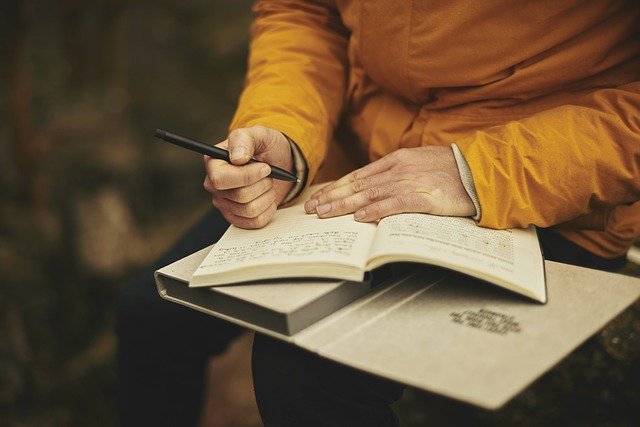
The next (and pretty enjoyable) step was to choose from among my many blank notebooks (I am a sucker for buying  notebooks. And I'm not a notebook snob - I have plenty of cheap notebooks from places like The Works in UK and Morrison here in Gib gathering dust among a couple of Moleskin). Ditto with the pen. If I was going to release that creative demon, then the weapon had to be just right. And I am also a sucker for buying pens - from felt tips to fountain pens. I settled for an A5 from Morrison in a bright, summery orange and a black biro from The Beacon Press. As cheap as chips. Cheaper, if you try to buy chips at Ocean Village.

And finally, I was ready to write.

But what about? Stumped again, I turned to the internet, and after procrastinating half the afternoon on social media, I googled the word 'journaling'. There is so much out there, the information is bewildering. I sifted through some, avoiding the ones about journaling to improve my life, and journaling being about self care and self discovery, or about stress management or career enhancement, and managed to muster together some ideas.


I guess journaling can be as simple as recording what you've done every day, or things that have impressed you recently, or carved themselves into your mind. You could journal about someone that caught your eye, or a place that left an impression. You can journal about feelings. You can just free write for the day, and that can be quite liberating and lead to some interesting morsels of writing you can use in a more structured piece.

Themes for your journal


I thought I might journal on a theme. I have to be careful though. My intention for writing a journal is to gather some thoughts and ideas, and to free up my writing. That is why I want to journal with a biro. I need the physical act of writing to tap into my creativity. Typing feels too much like being at work to me.

So what theme? Should I write about food, travel, current affairs, health, travel, money, a personal journey into spiritual discovery (no), the weather, the environment, a personal journey from fat and unfit to slimmer, trimmer and fitter (not likely, doomed to failure from the outset!). Should I make it a memoir? Now, that was an interesting thought.

I am not preparing to write a memoir nor an autobiography, but there are many stories stashed away in our memories. Not that we necessarily need to recount them as true to life stories, but sometimes they can inspire interesting pieces of fiction, or poetry. And as those memories are gathered, they become the story of my life, the lives of my children and grandchildren. I wish my mother would write her memories so that they can shed light on my childhood, and I wish my grandparents had the chance to write theirs.

Metro MadridSo I think this might be the path I go down. Let's see how far I get and whether I commit to it for any length of time. In the meantime, I dug out an old story I wrote based on a childhood memory. In '71, my family undertook the tricky journey from Gibraltar to Madrid in the early days of the closed border. Madrid was far different then than it is now, but for a seven-year old from Gibraltar who had never before got off the Rock, it was a vast and wonderful city: department stores, trams, the metro, boating lake, kiosks selling ice cream and 'granizado de limon'. And cows. There was a small byre at the bottom of the road where my aunt lived, with a few cows. I had never before seen a cow (nor smelt one!), nor watched one being milked. And here it was going on in a little backwater in one of the world's capital cities.

The memory was vivid and the story came easily. Maybe with the journaling, others will follow. The story, Spilt Milk, is on the Pages section of this blog, for your enjoyment.


Sunday, 15 March 2020

Pandemics, plagues and the human need to write it

Scene from The Last Judgement by Bosch courtesy of Pixabay


These are strange times we are living. I expected to write this blog post at the start of spring and write about the sorts of inspiration that spring has for writers, how to go out and observe and write about nature, or changing seasons - something on those lines. Or I would have tackled a review of the workshops on short story writing that I was involved with during Gibraltar's Youth Arts Jamboree just a week or two ago. 


Coronovirus - image courtesy of Pixabay


Now the workshops seem like forever ago, Gibraltar along with much of Europe is on the verge of a coronavirus pandemic lockdown and the world seems a far more terrifying place than it did last month. So how do writers reflect this? How do we work with this experience?

In some ways, a pandemic, like the plagues of old, give rise to countless stories.  A twentieth century example would be La Peste, by Albert Camus. We are pretty well served by apocalyptic fiction, post-apocalyptic dystopian fiction, fictional epidemics which wipe out almost all human life and others that give rise to different forms of life or even the living dead (I'm not sure we can refer to zombies as any kind of life form!). 


If reading fiction stories using these as a theme is an entertaining form of escapism, writing them is even better. Writing about disease and devastation has fascinated the world for centuries. Stories have been the means for spreading information since time immemorial. Telling stories about experiences, tales from the experiences of other nations, was how information spread from one community to the other in the days  before mass printing and, of course, the internet. Whether about real or fictional plagues, famines, diseases, war or natural disasters, people learn and explore their thoughts, emotions and ideas through stories.

We are flooded at the moment by news reports, much of it sensationalist, some of it false and misleading. What is particularly interesting now, in the midst of a worldwide pandemic the like of which has not been seen by anyone living, is that people have taken to writing about it. Writing down thoughts and experiences - whether electronically or on paper - seems such a natural response. We are recording and interpreting and communicating on a number of levels, especially when we write fictional accounts of the experience.


And, of course, I don't need to go into the therapeutic effects of writing. Even writing a diary entry of your observations on the pandemic will help to rationalise and allay those fears and anxieties, which even the most logical and calm of us will experience. Disease, plague, epidemics, pandemics - these are all emotive words. These are all situations which are extreme and which bring out some extreme reactions in people. 

Think about the scenes replayed on social media of panic buying and empty shelves in the supermarket, and of otherwise mild-mannered people fighting over a bag of macaroni. Panic spreads faster than the virus because human beings are emotional creatures; our instinct for self-preservation often over-rides our sense that self-preservation is best served through social support and communal action. What can I say? As a writer, these are all great themes to use in your next novel! But, on a therapeutic level, those fears and that anxieties and that sense of panic are better worked out on the page than in the streets.

This New York Post piece is an excellent example of what good journal writing can achieve. When you read this, it gives you an instant snapshot of what life was like in Crema in Italy during the lockdown. Perhaps writers in Gibraltar will do similar:

My Lockdown Diary

It will be interesting to see what books and films and poems and artworks emerge from the Covid19 pandemic. I would urge all writers to turn to their notebooks now. If we are having to stay at home for a period, then writing a journal of events, personal and national, would be a starting point. If the writing never goes beyond a journal entry, it will be a concrete, written record of the pandemic in Gibraltar, a part of our history. 

But perhaps, that journal entry will one day inspire a poem, a short story, a plethora of novels, a film, a painting. It will be your unique take on the Covid19 pandemic in Gibraltar, and one day it will be part of Gibraltar's literary history.

What will you be writing about the 2020 pandemic?